
Article: Handmade vs Handcrafted Jewellery. Why the Difference Matters.
Handmade vs Handcrafted Jewellery. Why the Difference Matters.
There is a question that comes up often in fine jewellery, and it deserves a real answer: what is the difference between handmade and handcrafted? The terms are used interchangeably in marketing, on shop floors, and across the industry but they are not the same thing.
Understanding the distinction will change the way you think about every piece you wear, commission, or give.
The Honest Definitions
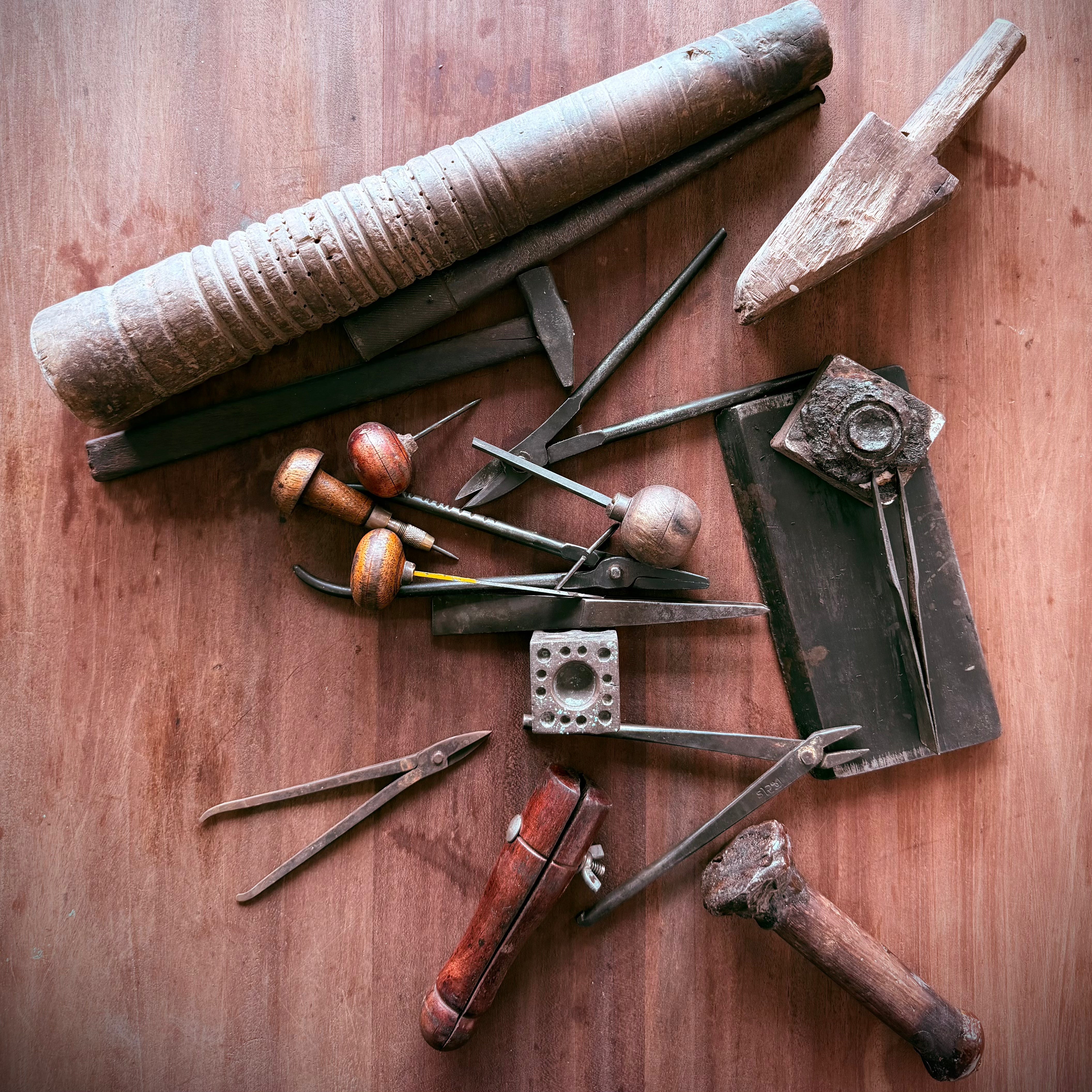
Handmade, in its purest sense, means made entirely by hand. No electric tools, no machinery, no mechanical assistance. Metal is cut with a hand saw, shaped with files, drilled by hand, finished with emery cloth. It is an uncompromising standard and a rare one. Very few jewellers in the world work exclusively this way, and fewer still can produce fine jewellery of consistent quality at that standard alone.
Handcrafted is the more honest and widely applicable term for the finest workshop jewellery made today. A handcrafted piece is built by a skilled artisan, by hand, in a small workshop but with access to specialist tools and equipment where they genuinely serve the work. The distinction that matters is this: handcrafted jewellery is never assembled from mass produced components, never cast from moulds produced in bulk, never part of a production line. Every piece passes through the hands of a maker who understands what they are building and why.
The clearest way to draw the line is not between tools and no tools. It is between intention and production volume.
Handcrafted means a maker at a bench, building one thing with full attention. Mass production means a factory optimised to build thousands of identical things as efficiently as possible.
What Mass Production Actually Means
Most jewellery sold in the world today including jewellery sold at significant price points in well known names is cast. A design is modelled, a mould is made, molten metal is forced into that mould under pressure, and the resulting casting is cleaned, polished, and set with stones. It is efficient, consistent, and scalable.
Casting is not inherently dishonest. But it is a fundamentally different object from a fabricated piece. A cast piece carries the limitations of its mould. It can lack the density, the surface quality, and the structural integrity of metal that has been worked directly. And it can be produced in any quantity. The ring a customer believes is special may share a mould with ten thousand others.
Rhodium plating is a useful example of how mass production can obscure its own compromises. White gold in high volume manufacturing is frequently plated with rhodium to achieve a brighter, whiter finish because the underlying alloy is often not white enough on its own. On a quality handcrafted piece, the alloy is chosen and worked to stand without plating. The surface you see is the material itself.

Where Hand Fabrication Stands Apart
There is a third category that sits above both: hand fabrication. This is the method that defines House of Jasmin.
Hand fabrication means building a piece from raw metal, sheet, wire, tubing, shaped, formed, soldered, and finished by hand at a bench. No casting. No mould. No replication. The metal is worked directly into the form the design requires. This is how jewellery was made for centuries before industrial manufacturing existed, and it is the tradition from which the finest craft lineage descends.
The difference is tangible. Fabricated metal is denser, harder, and more responsive to finishing than cast metal.
Settings cut directly into fabricated metal hold stones with a precision that cast settings cannot match. And because fabrication begins from raw material each time, no two pieces are ever truly identical even within a limited run.
This is not nostalgia. It is a technical choice with real consequences for the quality and longevity of the piece.
House of Jasmin. Built on This Distinction.
House of Jasmin was founded in Abu Dhabi on a single principle that has never moved: every piece is hand fabricated in our own workshop. Not cast. Not assembled from bought in components. Built from metal, by hand, one piece at a time.
Our collections are limited to twenty pieces per design. Our bespoke commissions are guaranteed as one of a kind originals, built to a specific brief, for a specific person, and never replicated. When a piece leaves our workshop, it is the only one of its kind in the world.
This matters because the story behind a piece of jewellery is as much a part of it as the metal and stones. The Zahra range, pear cut garnets in alternating directions, each set in a different pointed claw style, paired asymmetrically with freshwater pearls and catseye moonstones, exists because every design choice was made deliberately, resolved at the bench, and executed by hand. The Lucy, an engagement ring commissioned for one person and made once, was built from scratch using 100% traditional methods. Raw metal worked entirely by hand, no CAD, no casting, from the first forming of the shank to the final setting of the stone. Both pieces are different in form and purpose, but identical in their making.

Why It Matters When You Commission
When you commission a piece for someone you love, you are not buying an object. You are commissioning an object that holds a story, the thought behind it, the decisions made in its design, the hands that built it. A hand fabricated piece carries all of that in its structure.
Mass production can produce something that looks similar. It cannot produce something that is the same.
At House of Jasmin, every commission begins with a conversation. The design is drawn. The materials are chosen. The piece is built in our Abu Dhabi workshop, by hand, from the first cut of metal to the final setting. And when it is finished, it belongs entirely to the person it was made for.
House of Jasmin. Every piece begins with a story...
Read more
The Journey From Design to Jewel
Every piece of jewellery begins long before it reaches the hand. At House of Jasmin, the process is thoughtful and precise — a quiet balance of creativity, craftsmanship, and technical expertise. F...
Read more